

In addition to this sampling of videos, you can view our full YouTube playlist of Daoism and Ecology videos here.

In addition to this sampling of videos, you can view our full YouTube playlist of Daoism and Ecology videos here.
Ecological Civilization in China often draws on traditional philosophical lineages to articulate what “living well” might mean within ecological limits. Among these, Daoism offers a distinctive orientation: attention to harmony, restraint, interdependence, and the cultivation of a way of life aligned with the patterns of the natural world. In this Forum, Chen Xia (Chinese Academy of Social Sciences) explores how Daoist thought can inform—support, complicate, and deepen—the project of Ecological Civilization today. Moving beyond slogans, we’ll examine Daoism as a living intellectual and ethical tradition with relevance for contemporary challenges: environmental governance, cultural renewal, and the formation of ecological values in public life. In conversation with Stephen Posner and Mary Evelyn Tucker, we’ll consider questions such as: What elements of Daoist philosophy are most relevant to today’s ecological realities—and what gets misunderstood when Daoism is translated into modern policy language? How do Daoist ideas of cultivation (of self, society, and relationship with the more-than-human world) connect to the “inner–outer” demands of systems change? Can Daoist concepts such as gongsheng (symbiosis / co-flourishing) help reframe modern narratives of progress and development? What might Daoism contribute to global conversations on ecological ethics—without flattening cultural specificity?
This video is an excerpt from “Daoism in China's Climate Change Policy” webinar, co-organised by Manchester China Institute and Manchester Museum. Here, Martin Palmer discusses the unique Daoist understanding of the climate crisis and its impacts on the future of civil society action in China.
This digital story was created as part of the Green Religion course at Whittier College.
Dr. James Miller, Professor of Humanities at Duke Kunshan University, addresses some prevalent tensions within the field of religious studies: for instance, he suggests that Chinese religions are often framed as relics of the past in conflict with the predominantly Western forces of modernity. Dr. Miller suggests that scholars approach religious studies from the framework of a sustainable future—a paradigm that has the potential to overcome these tensions and reshape the disciplinary structures of the university.
In this Pulitzer Center symposium, journalists and scholars discuss environmental issues in China and the place of religion in responding to the nation's environmental challenges. Religion, the subject of official repression throughout much of China’s Communist era, is now experiencing rapid growth. More surprising still, Chinese government officials are invoking Confucianism, Daoism and other cultural traditions as part of the “ecological civilization” required to meet the country’s huge environmental challenges. Journalists, filmmakers and academic specialists from China and the United States explore these trends in these two panels moderated by Jon Sawyer, Executive Director of the Pulitzer Center on Crisis Reporting.
James Miller discusses Daoism and Ecology with Mary Evelyn Tucker. “Daoism and Ecology” is part of the larger “Conversations on World Religions and Ecology” project. Watch the whole “Conversations on World Religions and Ecology” series on the Forum on Religion and Ecology YouTube Channel.
Dr. James Miller, Professor of Humanities at Duke Kunshan University, offers his reflections on a Daoist response to Journey of the Universe. For Dr. Miller, Daoism speaks to a repeated patterning process that situates the human within the Earth, the Heavens, and the Way—a vision that dissolves the boundaries between our internal and external worlds. He suggests that both Daoism and Journey provide meditative opportunities to reshape our understanding of ourselves and our relationship to the natural world.
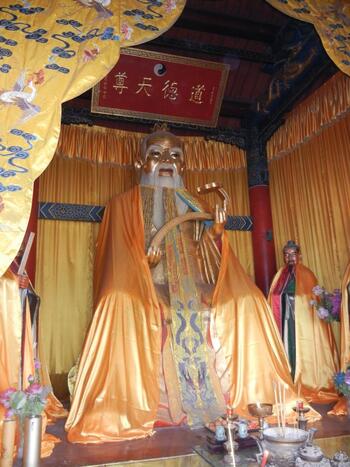
Header photo: MaoShan Lao Zi, Courtesy of ARC