

In addition to this sampling, you can view our full YouTube playlist of Confucianism and Ecology videos here.
In addition to this sampling, you can view our full YouTube playlist of Confucianism and Ecology videos here.
Across China’s long intellectual history, the classics have not only been texts to study, but practices to live—resources for cultivating character, clarifying responsibility, and shaping public life. In a moment of rapid modernization and ecological strain, renewed attention to classical traditions raises a timely question: how might practices of self-cultivation support social reform—and what are the limits of that hope? In this Forum, Daniel K. Gardner (Dwight W. Morrow Professor Emeritus of History and Environment, Smith College) draws on decades of scholarship on Confucian and Neo-Confucian traditions—especially the interpretive legacy of Zhu Xi—to explore how “reading” can function as a formative discipline: training attention, moral discernment, and a sense of obligation to the common good. In conversation with Stephen Posner and Mary Evelyn Tucker, we’ll explore: What does it mean, in the Confucian tradition, to read for self-transformation rather than information? How did thinkers like Zhu Xi connect inner cultivation to education, institutions, and reform? How might classical practices illuminate (or complicate) contemporary aspirations such as Ecological Civilization—especially where “tradition” is invoked in modern public discourse? What can modern leaders, educators, and communities responsibly take from the classics without romanticizing or instrumentalizing them? This Forum is designed for participants interested in the deeper cultural foundations of civilizational change—where ethics, learning, and governance intersect, and where transformation begins with how we form persons and publics.
On April 22, 2025, Mary Evelyn Tucker discussed Confucianism at the “Eco-community and Transformation of Human Civilization” Panel, a dialogue with villagers and eco-persons at the Cultural Village in Hangzhou, China.
On April 22, 2025, Mary Evelyn Tucker discussed Confucianism at the “Eco-community and Transformation of Human Civilization” Panel, a dialogue with villagers and eco-persons at the Cultural Village in Hangzhou, China.
Several scholars reflect on the contributions of Confucianism, and Chinese thought in general, to visions of an ecological culture in the age of climate change.
Mary Evelyn Tucker discusses Confucianism and Ecology with John Grim.
Watch the whole “Conversations on World Religions and Ecology” series on the Forum on Religion and Ecology YouTube Channel.
Philosopher Lu Feng of Tsinghua University in Beijing reflects on Confucian perspectives on the global environmental crisis as part of a symposium on religious and philosophical responses on contemporary environmental concerns.
Bill Moyers interviews Tu Wei-ming who discusses the relevance of Confucian philosophy to our times and the recent student movement in China. Tu Wei-ming suggests that the humanism of Confucius can help us sort out some of the ethical problems of today.
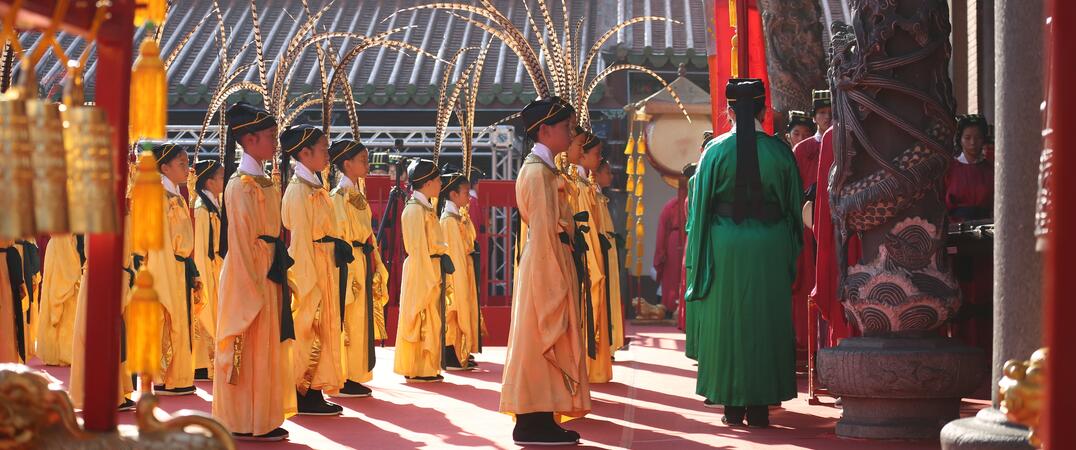
Header photo: Ceremony outside the Taipei Confucius Temple, Taipei, Taiwan